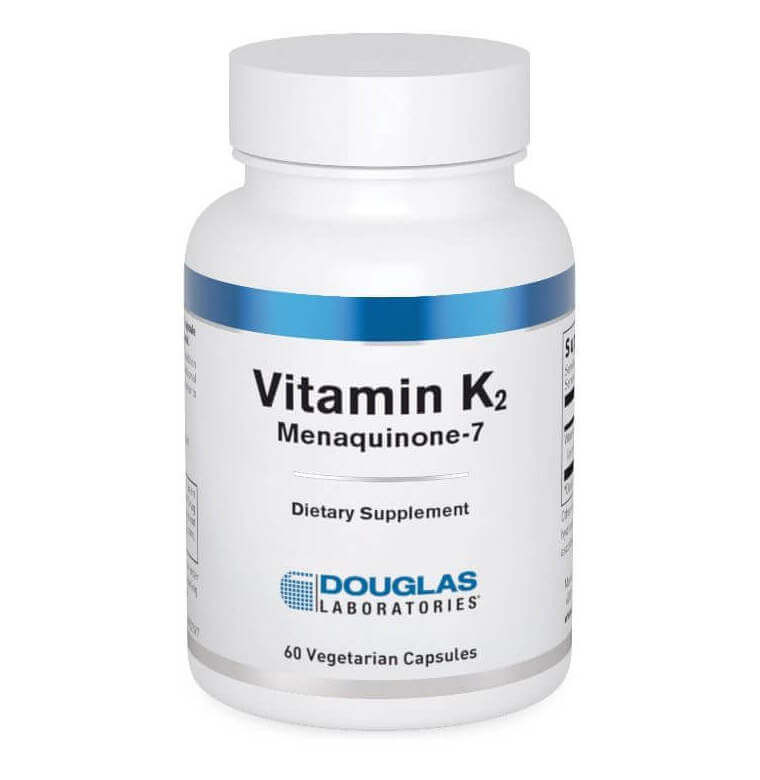
Vitamin K2
Menaquinone-7
DESCRIPTION
Vitamin K2, provided by Douglas
Laboratories®, supplies a significant amount of
biologically active vitamin K in the form of
menaquinone-7 (MK-7). This product is soy
free.
FUNCTIONS
Vitamin K was originally discovered as the antihemorrhagic
factor, but it now encompasses a
variety of physiological processes. The major
source of vitamin K in most diets is
phylloquinone (vitamin K1), which is present in
green leafy vegetables such as spinach, broccoli,
and kale. Vitamin K2 is present in small
amounts in fermented foods, milk products,
cheese, and meat, and is synthesized by various
human gut microbiota. It is well documented
that the Western population obtains insufficient
vitamin K from their regular diets, possibly
related to poor absorption from these foods.
Beyond blood clotting, the role of vitamin K in
osteoporosis and cardiovascular disease is
related to calcium utilization. Scientific studies
have revealed that vitamin K plays a crucial role
in building and maintaining bone health, which
is influenced by osteoblasts, osteoclasts,
hormones, cytokines and nutritional factors,
including vitamin K intake. Inadequate calcium
metabolism can result in cardiovascular and
bone health problems. The deposition of calcium
into arteries is an organized, regulated process
similar to bone formation that occurs when other
factors are present. Proteins like osteocalcin and
matrix Gla protein, which are actively involved
in the transport of calcium out of vessel walls,
are suspected to have key roles in coronary
calcium deposition. The greater the amount of
calcification, the greater the likelihood one may
develop suboptimal coronary health.
Additionally, research shows undercarboxylated
osteocalcin and low vitamin K intakes are risk
factors for fractures in women. Vitamin K is
needed to activate osteocalcin (carboxylated),
which functions to take calcium out of the
vessels and deposit them into the bones.
Therefore, consuming sufficient amounts of
dietary calcium is not enough for bone and
cardiovascular health; the body needs to
distribute and utilize the calcium properly with
aid of Vitamin K.
Vitamin K2 (as MK-7) is more bioactive and has
proven more effective than vitamin K1 and other
menaquinones. MK-7 showed eight times the
half-life of vitamin K1 in a 24-hour serum
concentration level after 1 mg of each form was
ingested. Thus, MK-7 can be administered in
low dosages only once a day, typically 1/1000
that of a MK-4 dose. Furthermore, the study
showed better utilization and improved
osteocalcin carboxylation for MK-7 after 6
weeks. Numerous studies reveal long-chain
menaquinones, such as MK-7 are more effective
in supporting arterial health than vitamin K1
menaquinones.
Douglas Labs’ Vitamin K2 as menaquinone-7
(MK-7) is derived from geraniol and farnesol.
Geraniol is the primary part of rose
oil, palmarosa oil, and citronella oil. Farnesol is
present in many essential oils such
as citronella, lemon grass, rose, and musk. This
natural form of MK-7 has been extensively
tested for molecular identity and bioequivalence
when compared to MK-7 from fermented
soybeans (natto). It is the all-trans form, thus
providing a significantly higher purity of the
only biologically active form.
INDICATIONS
Vitamin K2 may be a useful dietary supplement
for individuals who wish to increase their intake
of Vitamin K and support bone and
cardiovascular health.
Douglas
Laboratories®
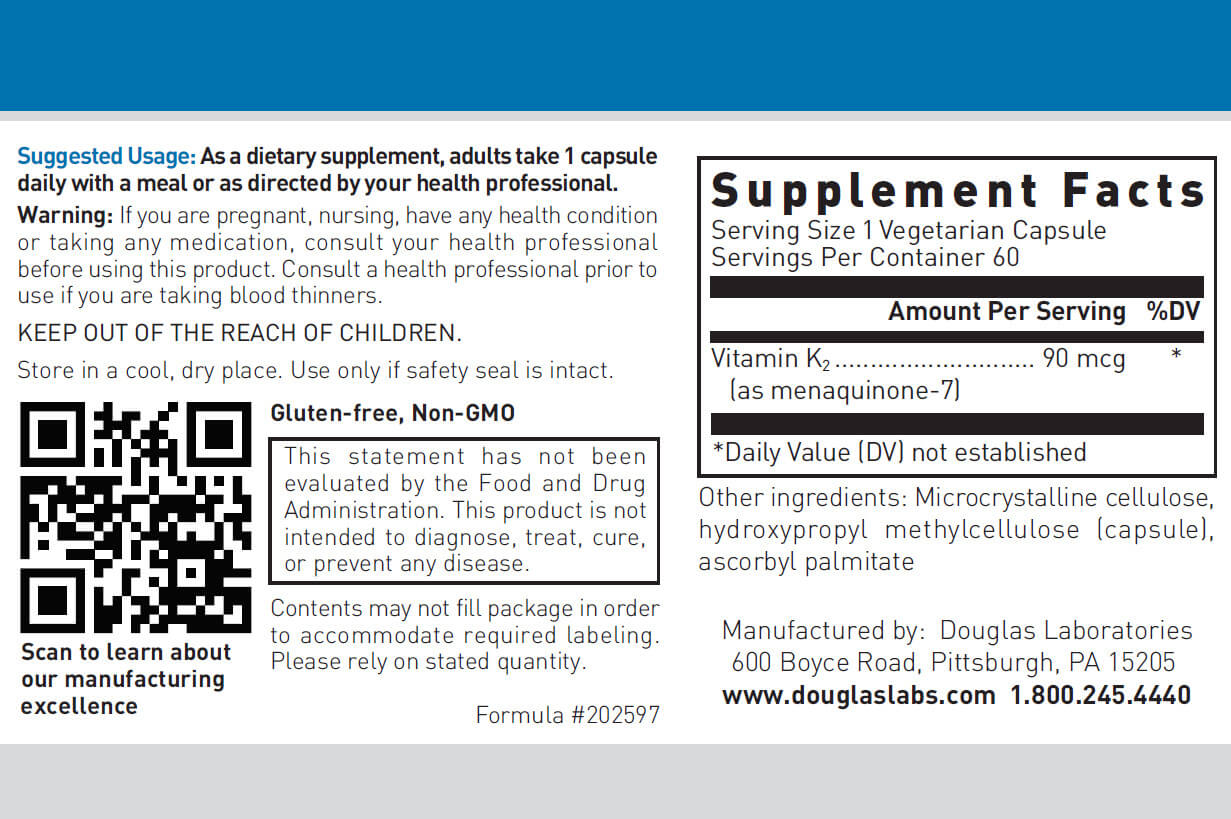
FORMULA (#200913)
1 capsule provides:
Vitamin K2 (as menaquinone-7)... ......... 90
mcg
Other Ingredients: Cellulose, vegetable stearate, calcium
citrate and silica
This product contains NO yeast, wheat gluten, soy protein,
milk/dairy, sodium, sugar, starch, artificial coloring,
preservatives or favoring.
SUGGESTED USE
Adults take 1 or more capsules daily with meals
or as directed by your health care professional.
SIDE EFFECTS
Warning: Vitamin K should not be taken with
blood thinners such as Coumadin (Warfarin)
unless your physician is notified prior to use.
STORAGE
Store in a cool, dry place, away from direct
light. Keep out of reach of children.
REFERENCES
Forli L, Bollerslev J, Simonsen S, Isaksen GA, Kvamsdal
KE, Godang K, Gadeholt G, Pripp AH, Bjortuft O. Dietary
vitamin K2 supplement improves bone status after lung and
heart transplantation. Transplantation. 2010 Feb
27;89(4):458-64
Prabhoo R, Prabhoo TR. Vitamin K2: a novel therapy for
osteoporosis. J Indian Med Assoc. 2010 Apr;108(4):253-4,
256-8.
Lanham-New SA. Importance of calcium, vitamin D and
vitamin K for osteoporosis prevention and treatment. Proc
Nutr Soc. 2008 May;67(2):163-76.
Booth SL. Roles for vitamin K beyond coagulation. Annu
Rev Nutr. 2009;29:89-110. Review.
Gijsbers BL, Jie KS, Vermeer C. Effect of food
composition on vitamin K absorption in human volunteers.
Br J Nutr. 1996 Aug;76(2):223-9.
Schurgers LJ, Teunissen KJ, Hamulyák K, Knapen MH,
Vik H, Vermeer C. Vitamin K-containing dietary
supplements: comparison of synthetic vitamin K1 and
natto-derived menaquinone-7. Blood. 2007 Apr
15;109(8):3279-83.
van Summeren MJ, Braam LA, Lilien MR, Schurgers LJ,
Kuis W, Vermeer C. The effect of menaquinone-7 (vitamin
K2) supplementation on osteocalcin carboxylation in
healthy prepubertal children. Br J Nutr. 2009
Oct;102(8):1171-8.
Rennenberg RJ, de Leeuw PW, Kessels AG, Schurgers LJ,
Vermeer C, van Engelshoven JM, Kemerink GJ, Kroon
AA. Calcium scores and matrix Gla protein levels:
association with vitamin K status. Eur J Clin Invest. 2010
Apr;40(4):344-9.
Yamauchi M, Yamaguchi T, Nawata K, Takaoka S,
Sugimoto T. Relationships between
undercarboxylated osteocalcin and vitamin K intakes,
bone turnover, and bone mineral density in healthy
women. Clin Nutr. 2010 Dec;29(6):761-5.
Gast GC, de Roos NM, Sluijs I, Bots ML, Beulens JW,
Geleijnse JM, Witteman JC, Grobbee DE, Peeters PH, van
der Schouw YT. A high menaquinone intake reduces the
incidence of coronary heart disease. Nutr Metab Cardiovasc
Dis. 2009
Kidd PM. Vitamins D and K as pleiotropic nutrients:
clinical importance to the skeletal and cardiovascular
systems and preliminary evidence for synergy. Altern
Med Rev. 2010 Sep;15(3):199-222.